

Table of Contents
- What Is Business Process Gap Analysis?
- Is Process Gap Analysis the Same as Business Gap Analysis?
- Types of Process Gaps
- What Are the Warning Signs That a Process Has Gaps?
- How to Conduct a Business Process Gap Analysis
- Benefits of Fixing Gaps in Processes
- How AI Can Help Identify Business Process Gaps
- Common Mistakes to Avoid
- Turn Process Gaps Into Measurable Improvements
Summary
Business process gap analysis helps organisations identify the difference between current performance of the business with the goals they want to avhieve. By uncovering the causes of process gaps and prioritising the right improvements, businesses can reduce inefficiencies, use resources more effectively, and move forward to business growth. AI-powered process analysis can accelerate this process by helping teams identify improvement opportunities faster.
A process may look perfect on paper until it starts piling up delays in goal achievement, employees spend hours on repetitive tasks, or targets remain out of reach.
These issues often indicate that there is some gap between how a process currently operates and how it needs to perform.
The real problem is figuring out where the problems come from. Is there a problem with a task that is slowing down the whole process? Or does the process itself need an update?
Using a structured business process gap analysis, you can find out the answers to these questions effortlessly and take improvement actions on them.
Below, we will get to know how to recognise process gaps, identify what causes them, and decide which changes can make a real difference.
What Is Business Process Gap Analysis?

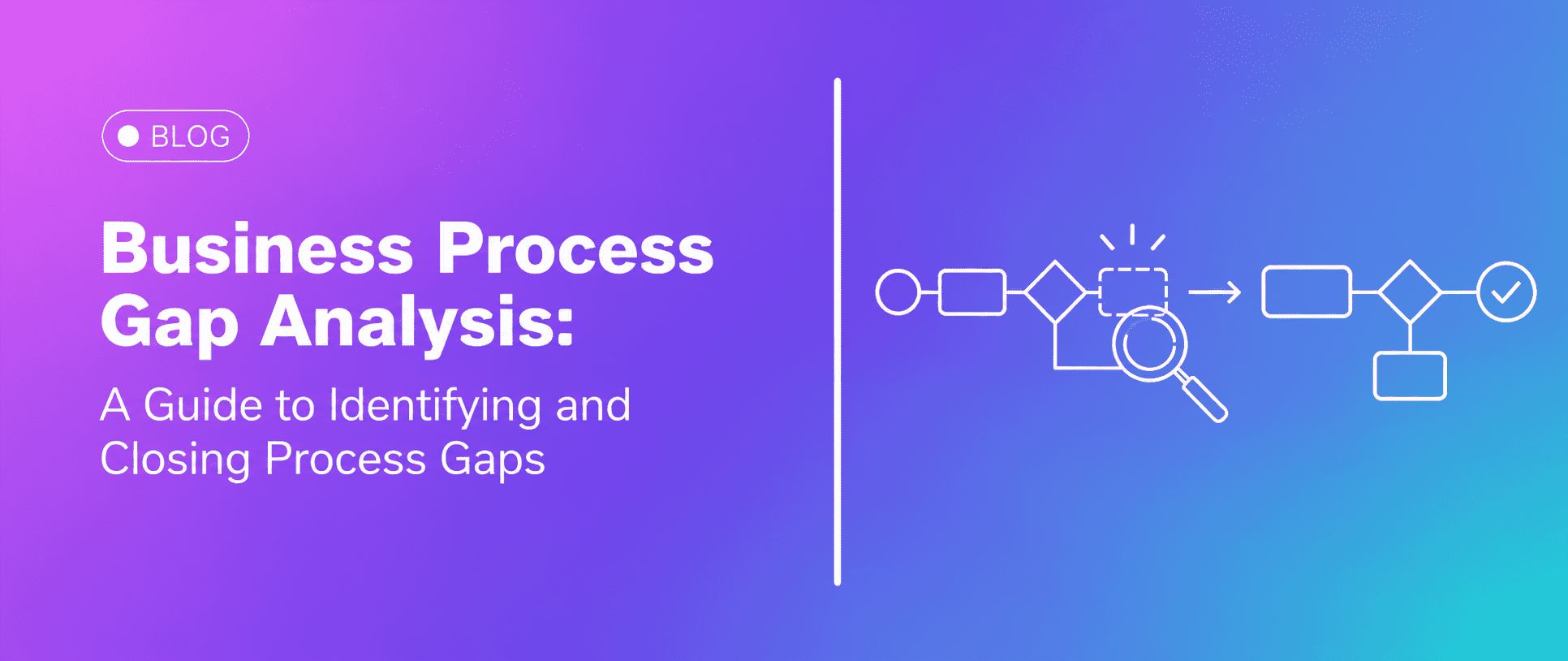
Business process gap analysis is the practice of comparing the current state of your business processes with the desired state to identify differences in performance, execution, or outcomes.
The current state (as-is processes) describes how your processes operate today, while the desired state (to-be processes) describes how they should perform to meet your business requirements. The difference between as-is to-be processes will tell you that there is a gap in the process.
The purpose of analysing process gaps is to determine whether your business processes are performing as expected and identify where changes may be needed to achieve your desired business outcomes.
Is a process gap analysis the same as a business gap analysis?
No. People often get confused between the two terms. But they operate at different levels.
Business gap analysis is a wider term that helps businesses compare current business capabilities or performance with what they need to achieve strategic goals. The gap can be in technology, skills, resources, or business capabilities.
On the other hand, business process gap analysis mainly focuses on specific processes that help operate the business. Teams analyse how work moves through activities, decisions, roles, and systems to examine where the process falls short in delivering the desired outcomes.
Types of Process Gaps
Process gaps can occur at different points in a workflow. Understanding the types can help your teams to find out the right issues to resolve. Below are the common types of process gaps that organsiataions can analyse based on the problem they are facing.
Performance Gaps: This occurs when a process is not providing the expected outcomes. When you notice missed service-level targets, longer-than-expected turnaround times, and inconsistent results, it means there is a performance gap in your process.
Efficiency Gaps: Sometimes you feel like a process is consuming more time, effort, and resources than it should be. It may have duplicate tasks, excessive approvals, unnecessary handoffs, and non-value-adding work that are causing efficiency gaps.
Compliance and Control Gaps: Every industry needs to follow policies, procedures or controls. But while executing so many complex processes, you might miss following them. When process execution does not align with required policies, procedures, or controls due to missing checks or inconsistent approval practices, it results in compliance and control gaps.
Roles and Responsibility gaps: A process may lack clear ownership for particular activities or decisions. When employees are unsure who should act next or who has approval authority, work can stall or be completed inconsistently.
Technology and automation gaps: It is possible that your existing systems do not adequately support the process anymore. Manual data transfers, disconnected applications, and repetitive administrative tasks can create opportunities for standardisation or automation.
Documentation and knowledge gaps: Process documentation may be incomplete, outdated, or inconsistent with actual execution. Employees may rely on individual knowledge or informal workarounds, making the process difficult to understand and standardise.
What Are the Warning Signs That a Process Has Gaps?
If you are noticing recurring issues and persistent deviations from expected performance, it becomes essential to conduct a closer examination.
Look for the following warning signs:
- Repeated delays
- Frequent rework
- Inconsistent outcomes
- Excessive approvals and handoffs
- Growing operating costs
- Unclear process ownership
- Dependence on workarounds
- Performance targets are consistently missed
How to Conduct a Business Process Gap Analysis

Now, what is the correct way to identify these process gaps and close them? Here is a separate section to understand both. The following approach keeps the analysis focused on decisions and measurable results.
How to Identify the Gaps
Following steps will help you identify the process gaps:
-
Define the process and the objective
The first step should be identifying the processes you should examine and the business outcome you expect to achieve. It is important to establish a clear objective to prevent the analysis from expanding into unrelated operational issues.
For example, the objective might be to reduce purchase order approval time, improve first-time accuracy in customer onboarding, or strengthen compliance with an internal procedure.
-
Establish the current state process map
Then, document how the process is actually working. Map your processes, including activities, decision points, roles, handoffs, systems, and exceptions.
Process mapping is the foundational step to understand what’s happening currently. Get involved with people who perform the processes on a daily basis to create an as-is process. Only they can help you understand the actual process.
A structured process map helps you see the end-to-end workflow rather than examining isolated activities.
-
Design the desired state process map
After creating the current state process map, create a to-be process map based on the objective you want to achieve. The desired state needs to be realistic and should align with your business requirements.
-
Compare the current and desired states
Now that you have the as-is and to-be process maps, you can start identifying the difference between actual process performance and the expected outcome.
-
Investigate the underlying causes
Examine the activities and decisions associated with the gap. Review available performance data, process documentation, and feedback from the people who perform or manage the work. Determine whether the issue results from the process design, unclear responsibilities, missing information, unnecessary activities, technology limitations, or another cause. The goal is to understand what needs to change, not merely describe what is going wrong.
How to Close Those Gaps
When you identify the process gaps using the above steps, it’s time to fix those processes.
-
Identify and prioritise improvement opportunities
Once the causes are understood, determine which changes are most likely to address them. Potential improvements may include removing unnecessary steps, clarifying approval responsibilities, standardizing activities, improving information flow, or automating repetitive work.
Prioritise these opportunities according to the expected business impact, implementation effort, risk, and alignment with organizational objectives.
-
Implement the required changes
Translate the selected improvements into specific actions. Assign ownership, communicate changes to affected employees, update process documentation, and establish any necessary training or controls.
Changes should address the identified causes.
-
Measure whether the gap has closed
Compare post-implementation performance with the original baseline and target. Use relevant measures such as cycle time, error rates, process cost, rework, or compliance outcomes.
If the results do not meet expectations, revisit the analysis. The original cause may have been incomplete, or the change may have introduced another issue.
This final step is essential because implementing a change does not automatically mean the process has improved.
Benefits of Fixing Gaps in Processes
The benefits from analysing process gaps will come after you implement the improvements. And the benefits depend on what type of issue you are resolving. A few of them are:
Improve operational efficiency: Once you remove unnecessary activities and reduce unnecessary delays, you are actually giving a way to your teams to work more efficiently with less wasted effort.
Better Utilisation of Resources: When your team starts working efficiently, they will get space to focus on other important activities, which can bring innovation and growth in your business.
Consistent Customer Experience: With standardised workflows, clarified roles and responsibilities, and maintained reliable process maps, the team follows a common approach. This ensures that your customers will get same products and services no matter where the branch is.
Achieve Strategic Goals More Efficiently: Closing process gaps helps align day-to-day operations with broader goals such as improving service quality, reducing costs, or increasing productivity.
Ultimately, fixing process gaps helps your organisation build a stronger operational foundation that will result into sustainable growth. The real value comes from ensuring that processes do not just function as intended but actively support the business outcomes the organisation wants to achieve.
How AI Can Help Identify Business Process Gaps
Now it is clear what process gaps are, why it is important to fix these gaps, and how to fix them. But the key challenge is still there. The traditional way of finding these inefficiencies is heavy lifting and resource-intensive. Teams need to connect with the right stakeholders and spend time understanding and mapping the processes. By the time they reach analysis, it may be possible that the original process has changed.
AI is helping to bring speed to performing these activities. Let’s see how:
Faster Process Mapping
Process mapping itself is a time-consuming task. AI process mapping tools can help you accelerate process mapping time by up to 90%. You just need to upload what information you have about a process you want to map. It can be in any format, such as images, documents, videos, or even an audio recording. The tool has the power to convert this information into ready-to-use, BPMN-compliant process maps in minutes. No need to start from scratch. You can start quickly with what information you have.
Quick Insight on Inefficiencies
When you have the process map ready, the next challenge is to analyse it. Teams need to search manually to find out where the inefficiencies are. The AI automatically flags the inefficiencies after evaluating structure, flow, roles, handoffs, approvals, and exceptions. It automates the heavy lifting of analysis, freeing up teams and BPM teams to focus on implementation.
Evaluate improvement opportunities
With the insights on so many inefficiencies, it becomes difficult to make decisions on which improvement opportunity to consider first. The AI-powered BPM tool helps you prioritise improvement opportunities based on its impact on time, cost, and efficiency.
Simulate Process Changes to Implement Better Improvement Decisions
The artificial intelligence tool also allows you to compare the different scenarios before implementing the changes. This helps process analysts and improvement teams compare options and focus on opportunities with stronger potential business value.
Common Mistakes to Avoid
Even a well-defined gap analysis can fail to deliver meaningful improvements if you follow an unstructured approach. The following mistakes can weaken the findings or prevent organisations from acting on them.
No clear objective
A gap analysis without a defined objective can become an open-ended review of every possible process issue.
Tracking irrelevant metrics
Collecting large amounts of data does not necessarily produce useful insights. Metrics that do not relate to the process objective can distract teams from the issues that matter.
Ignoring the bigger picture
A problem in one activity may originate elsewhere in the workflow. Improving a single step without considering upstream dependencies, downstream effects, and handoffs can shift the problem rather than resolve it.
Treating process gap analysis as a one-time task
Processes evolve as business requirements, technology, regulations, and customer expectations change. A process that performs well today may develop new gaps later.
Confusing Symptoms With Root Causes
A missed deadline or rising error rate identifies a problem, but it does not explain why the problem exists. Acting on assumptions can lead to ineffective solutions.
Relying on Outdated or Inaccurate Process Documentation
A gap analysis based on an inaccurate process map can produce misleading conclusions. Employees may have developed workarounds or changed how they execute activities without updating the documentation.
Turn Process Gaps Into Measurable Improvements
Business process gap analysis helps organisations like yours to understand why existing workflows is not providing intended outcomes and what needs to change. You can identify the gaps that matter most and translate the findings into measurable improvements.
A structured approach is mapping current and future state process maps and comparing both to find out where the activities are falling short.
Doing it using traditional methods is a time-consuming task. AI is further making this work faster by accelerating process mapping and analysis. With business process management tool, such as PRIME BPM, teams can reduce manual effort, uncover potential inefficiencies, and evaluate improvement opportunities more quickly.
Want to see how you can quickly identify process gaps and implement improvements faster?