

Top 10 BPM Tool Features Driving Smarter Business Operations in 2026 and Beyond
- Why BPM Tools Are Becoming Strategic Business Assets
- How AI Is Redefining BPM Expectations in 2026
- Top 10 BPM Tool Features Businesses Need in 2026 and Beyond
- A Thing That a Business Should Never Ignore – Customer Support
- Which BPM Features Should Your Business Prioritize?
- List of 5 BPM Tools to Compare
- Choose a BPM Tool with Smart Features
- FAQs
Business process management plays a critical role in keeping operations structured, efficient, and disruption-free. However, traditional BPM approaches often require significant manual effort to map, analyse, document, and monitor processes.
Modern business process management tools are changing this approach by reducing manual effort and accelerating the entire BPM lifecycle by 90%. As 2026 becomes increasingly driven by AI innovation, the rise of AI-powered BPM is helping organisations map, analyse, and improve processes much faster than before.
Businesses can now gain quicker insights, make better decisions, and focus more on implementing improvements rather than spending time on repetitive tasks.
However, selecting the right BPM platform is not always straightforward. With so many options available, businesses need to understand which BPM tool features truly matter, which capabilities support long-term operational growth, and what to evaluate before investing.
In this blog, we explore the essential features organisations should look for when selecting BPM tools 2026 and beyond to support smarter, faster, and more scalable business operations.
Why BPM Tools Are Becoming Strategic Business Assets
Businesses today are under constant pressure to deliver faster, improve customer experiences, and stay competitive in rapidly changing markets. Operational inefficiencies can directly impact customer satisfaction, revenue, and overall business growth.
When departments work in silos, teams struggle to maintain visibility across operations. It often leads to duplicated efforts, communication gaps, delays in approvals, and inconsistent processes. As a result, businesses find it difficult to meet growing demands efficiently.
This is why modern BPM tools are becoming strategic business assets rather than just operational support systems.
By using intelligent business process management tools, organisations can connect teams, standardize workflows, improve collaboration, and streamline end-to-end operations.
Most importantly, effective process management helps organisations to do more with less, reduce operational waste, and achieve a stronger return on investment (ROI). In an increasingly competitive business environment, companies that continuously optimize their processes are far better positioned to scale and adapt successfully.
How AI Is Redefining BPM Expectations in 2026
The biggest transformation happening in business process management is the rise of Artificial Intelligence.
In 2026, the integration of AI-powered BPM is bringing a new level of speed, accuracy, and efficiency to process management initiatives.
This growing demand is clearly reflected in current adoption trends. A recent survey revealed that nearly 78% of organisations are already using AI in at least one key business function, up significantly from 55% just a short time ago. This rapid increase shows how quickly businesses are shifting toward AI-driven operational strategies to improve efficiency, agility, and decision-making.
Businesses, whether SMEs or big organisations, want intelligent platforms that will streamline their effort and allows to implement BPM Trends 2026. They want a platform that helps their teams to spend less time on non-value-adding tasks and more time on implementing actual improvements.
As AI capabilities continue evolving, BPM platforms are becoming proactive operational intelligence systems instead of passive workflow repositories.
Top 10 BPM Tool Features Businesses Need in 2026 and Beyond
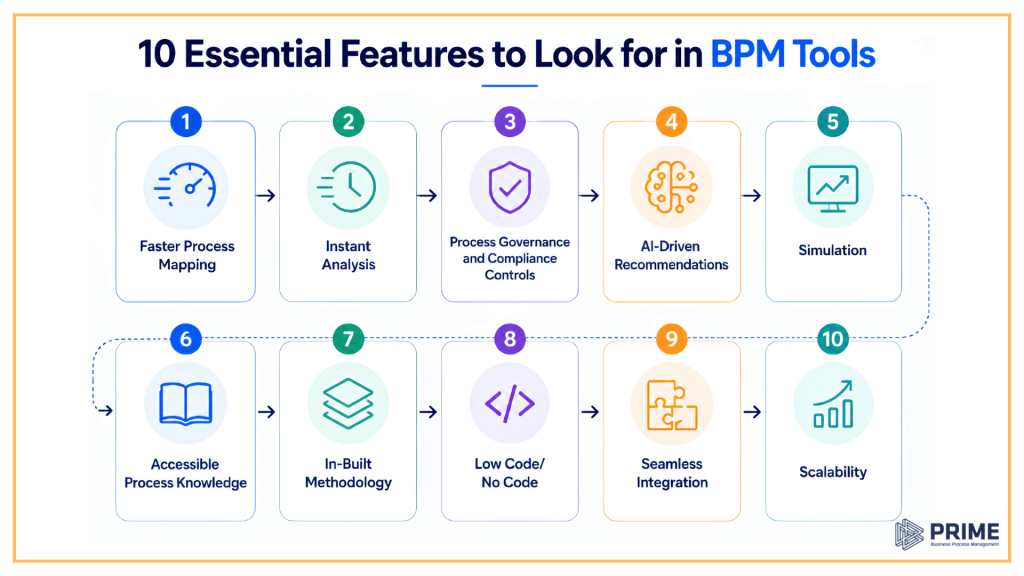
Below are the smart BPM software features that businesses should consider in 2026. These features will help businesses grow beyond 2026.
Quick Process Mapping to Understand Current State
Before improving operations, businesses must first understand how their processes actually work.
AI-powered BPM platforms should make process mapping fast, collaborative, and highly visual. Organisations no longer have time for lengthy documentation exercises that take months to complete.
Some advanced platforms, like PRIME BPM, have now designed process mapping agents that allow organisations to quickly convert their existing process information into a well-structured, accurate, and editable BPMN-compliant process map. This process information can be in any input, such as an image, a spreadsheet, a recording of a boardroom conversation, or even a video.
This capability is becoming one of the most valuable BPM software features for organisations pursuing operational excellence.
AI-Driven Analysis to get Instant and Accurate Insights
A modern BPM platform must have intelligent analysis capabilities to automate the heavy-lifting of manual analysis.
AI-driven process analysis enables businesses to gain real-time process insights into bottlenecks, risk, cost, time, value, efficiency, etc., by evaluating structure, flow, roles, handoffs, approvals, and exceptions. It will also flag which tasks are causing delays, so you know exactly where time, effort, and cost are being wasted and take quick action.
It strengthens process intelligence by helping organisations understand how processes perform under real operational conditions.5
Advanced Process Governance and Compliance Controls
As businesses grow, maintaining process consistency becomes increasingly difficult. Without proper governance, businesses often face inconsistent workflows, compliance risks, and limited process visibility.
BPM tools should provide advanced governance capabilities that help organisations standardize operations and keep processes compliant, audit-ready, and aligned with business goals.
Choose only leading business process management tools that can benchmark processes against internal best practices and industry standards to quickly identify performance gaps and improvement opportunities.
Some advanced AI BPM platforms can also automatically detect and correct naming issues, flow overlaps, connector errors, and logical inconsistencies, ensuring process maps remain standardised, compliant, and audit-ready.
AI-Driven Recommendation to Make Quick Decisions
One of the biggest advantages of modern AI-powered BPM platforms is that they help businesses make faster and smarter decisions without spending weeks manually reviewing processes.
Instead of depending entirely on teams to analyse workflows step by step, intelligent BPM systems can evaluate processes across important operational areas like compliance, efficiency, accuracy, risk, and overall performance. Some advanced platforms, like PRIME BPM, assess workflows using more than 37 critical data points to generate recommendations that are practical, scalable, and aligned with business goals.
This gives organisations clearer direction on where processes can be improved, what issues need immediate attention, and which changes can create the biggest operational impact.
Simulation to Support Better Decisions
Process simulation allows businesses to test different scenarios of operations before implementing any changes. It helps organisations to make smart data-backed decisions. Organisations can avoid costly mistakes that can impact ROI.
This capability is especially useful for enterprises managing large-scale transformation initiatives. They can simulate different scenarios before implementing ERP, process automation, and digital transformation.
Easy Access to Process Knowledge
Many organisations struggle because critical process knowledge remains trapped inside the process, and teams need to dig deeper to know what they are actually expected to do.
Modern BPM tools should make process knowledge easy to access, understand, and use across the organisation. Some advanced platforms now offer AI-powered chat capabilities where users can simply ask questions in plain language and receive instant, role-based answers.
Instead of manually searching through hundreds of process maps or procedures, employees can quickly find relevant information about how a process works, which workflows are highly manual, what changes were recently made, or where bottlenecks exist.
This makes process knowledge more accessible across the business, not just for BPM specialists or analysts, but for every team involved in day-to-day operations.
In-Built Methodology
Many organisations struggle with process improvement because they often lack a structured approach to analyse, improve, and manage processes effectively. This is why BPM tools today should include a built-in methodology that guides businesses through every stage of the BPM lifecycle.
BPM platforms that combine improvement frameworks such as Lean, Six Sigma, BPM, Value Stream Mapping, and Total Quality Management within a single system are becoming a preferred choice in 2026. This best-of-breed approach helps businesses manage improvement initiatives more effectively and consistently.
Low Code/No Code to Make the tool Easy to Adapt
Businesses today need BPM tools that are flexible, user-friendly, and easy to adapt without relying heavily on technical teams for every small change.
Modern low-code BPM tools should allow business users to manage workflows through simple drag-and-drop and plug-and-play capabilities. This reduces the need for coding knowledge and makes the platform easier to use across teams.
It further helps teams make process updates faster, respond quickly to operational changes, and improve adoption without constant IT dependency.
The easier a BPM platform is to use and adapt, the faster organisations can scale process improvement initiatives and drive operational efficiency across the business.
Seamless Integration
Teams rely on multiple platforms for finance, HR, CRM, communication, and operations. If a BPM platform cannot connect smoothly with existing systems, businesses often end up creating more silos instead of removing them.
Choose business process management tools that can integrate seamlessly with other enterprise applications so information can flow across systems without manual effort.
Scalability
Being a business owner, you always need a solution that can support future growth as operations become more complex.
Always go with a scalable BPM platform. As businesses grow, their operational requirements also evolve, and the BPM system should be flexible enough to grow alongside them.
This is why many organisations have shifted toward cloud BPM solutions that offer greater flexibility, accessibility, and scalability.
A Thing That a Business Should Never Ignore – Customer Support
No matter how advanced a BPM platform is, businesses still need the right support to make the most of it. BPM implementation often comes with process challenges, change management issues, and questions around improvement priorities.
That is why it is important to choose a vendor that provides real guidance throughout the journey. They must provide dedicated customer success managers to give you strategic support and ensure regular progress reviews.
And when support is needed, businesses should be able to talk to real BPM experts, not just bots or generic support teams.
Strong customer support helps organisations align BPM initiatives with business goals, overcome implementation hurdles faster, and maximize the value of their BPM investment.
Which BPM Features Should Your Business Prioritize?
The right BPM tools for your business largely depend on two things: your business size and the operational challenges you are trying to solve.
If you are a small or mid-sized business, it is usually better to prioritize features that are easy to adopt and deliver quick operational improvements. This may include process mapping, low-code capabilities, and AI-driven insights that help teams work faster without adding complexity.
For large enterprises, the priorities are often different. Enterprise-level organisations typically require stronger governance controls, advanced analytics, scalability, integrations, and audit tracking. They also need enterprise-wide process visibility to manage complex operations across multiple departments.
Your priorities should also depend on the outcomes you want to achieve. For example:
- If your goal is to improve operational visibility, prioritise process mapping and analytics.
- If compliance and standardisation are key concerns, focus on governance controls and audit capabilities.
- If your business is scaling quickly, prioritize scalability, integrations, and flexible low-code features.
- If you want faster decision-making, look for AI-driven recommendations and real-time process insights.
The best approach is to first identify what is slowing down your operations and then choose BPM features that directly help solve those challenges.
List of 5 BPM Tools to Compare
Here are five top BPM tools that businesses can explore:
PRIME BPM
PRIME BPM is an end-to-end AI-powered BPM platform designed to help organisations move from process mapping to operational excellence much faster. It combines intelligent AI technology with proven BPM methodologies to help businesses achieve better operational outcomes with less manual effort.
The platform enables organisations to complete process mapping up to 90% faster and turn weeks of process analysis into minutes. It also provides intelligent insights into workflows without requiring teams to manually dig through complex process maps.
Its AI capabilities also help quickly identify bottlenecks, inefficiencies, compliance gaps, automation opportunities, and improvement areas. This allows businesses to move faster compared to traditional BPM approaches.
PRIME BPM includes four BPM AI agents that handle repetitive and non-value-adding BPM activities. This allows teams to spend less time on manual process work and focus more on improvement and transformation initiatives.
The platform also includes built-in process improvement methodologies such as Lean, Six Sigma, BPM, Value Stream Mapping, and TQM. These methodologies help organizations implement scalable and consistent process improvements across the business.
Another area where PRIME BPM stands out is customer support. Businesses are supported by experienced BPM professionals who help create customised implementation plans aligned with organisational goals and operational priorities. Instead of relying on bots, users have access to real BPM experts who can provide practical guidance throughout the BPM journey.
Additionally, organisations gain access to an exclusive user community where they can participate in peer-led sessions, share experiences, and explore upcoming product updates. Users can also engage directly with the PRIME BPM product team to maximise the value of their investment.
Sign up for a 15 Day Free Trial today to check out its features.
Explore AI-Powered BPM in Action
Sign up for a 15 Day Free Trial today and experience faster process mapping, instant analysis, and intelligent BPM insights.
Bizagi
Bizagi provides process modeling, workflow automation, and low-code application development capabilities. It is commonly used by businesses looking to streamline workflows and improve operational efficiency.
Some advanced features may require additional technical expertise, depending on the complexity of implementation.
Nintex
Nintex focuses on workflow automation, document management, and process optimisation. The platform supports organisations looking to automate repetitive operational tasks across teams.
However, some users believe there is still room for improvement in the platform’s customer support experience.
SAP Signavio
SAP Signavio provides process mining, process modeling, analytics, and collaboration capabilities to help organisations better understand and optimize their operations.
It is particularly useful for businesses managing large and complex workflows across multiple departments.
Due to its enterprise-focused capabilities, implementation and adoption may require more structured planning and process maturity.
Kissflow
Kissflow is a low-code, no-code platform that helps businesses create, manage, and automate workflows without heavy technical expertise. The platform offers drag-and-drop workflow building, making it easier for teams to design and manage business processes quickly.
The platform is easy to adopt for basic workflow needs. However, businesses with more complex BPM requirements may need advanced customization capabilities.
Choose a BPM Tool with Smart Features
The role of BPM tools is rapidly evolving. Businesses today need more than basic workflow management. They need intelligent platforms that can help teams work faster, improve decision-making, strengthen governance, and drive continuous operational improvement.
The right BPM platform should align with your business size, operational challenges, and long-term goals.
As businesses continue moving toward AI-driven operations in 2026 and beyond, choosing the right BPM platform is becoming increasingly important.
Investing in a solution with smart and future-ready capabilities can help organisations stay competitive and efficient in the long run.
Always go with a free trial first to make any decisions.