

Global uncertainty has become a constant factor in business environments. Geopolitical tensions such as the Iran–US conflict are influencing supply chains, pricing volatility, regulatory expectations, and operational stability across industries.
Organisations are under pressure to remain functional despite these disruptions. Many already have Business Continuity Plans (BCPs) in place. However, during real-world disruptions, execution gaps often surface.
Operational resilience is defined as the ability to continue delivering critical services while managing and adapting to disruptions. Achieving this level of resilience requires more than documented plans. It requires processes that can sustain execution under pressure.
Before developing or refining a BCP, organisations need to optimise their processes. This ensures that risks are visible, dependencies are understood, and responses can be executed effectively when disruption occurs.
This article explores how organisations can strengthen operational resilience through process optimisation and build continuity capabilities that perform when needed.
Common Challenges Organisations Can Face at the Time of Global Disruptions
Disruptions expose operational gaps that often remain hidden during stable conditions.
Some of the most common challenges include:
- Teams lack a clear understanding of how processes connect across departments, making it difficult to assess impact areas.
- Critical tasks rely heavily on specific employees, increasing vulnerability when availability is affected.
- Continuity plans exist as separate frameworks without integration into operational workflows.
- Decision-making slows down due to unclear ownership and escalation paths.
- Regulatory obligations become harder to manage when processes are inconsistent or undocumented.
Operational risk is frequently linked to failures in processes, systems, or external events. During disruption, these risks intensify and directly impact continuity.
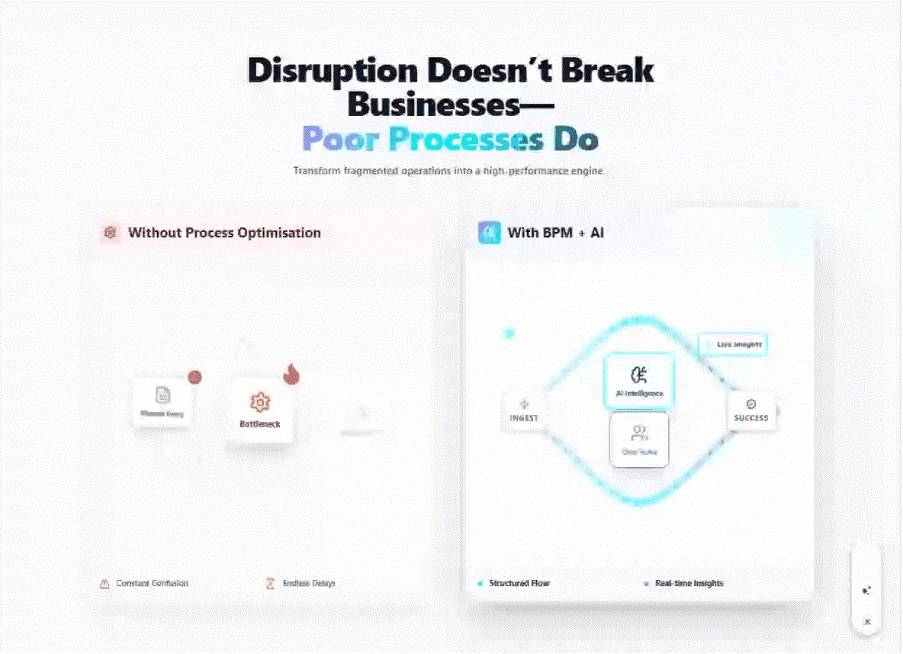
Building Resilience That Actually Works: 5 Process Optimisation Moves Executives Must Make
Operational resilience is shaped long before disruption occurs. It is reflected in how processes are designed, how decisions are structured, and how clearly execution is defined across the organisation.
For leadership teams, it is a strategic shift—one that places process optimisation at the centre of continuity, risk management, and execution.
1. Map and Document Business Processes
Resilience begins with clarity. Without a clear understanding of how work flows across functions, organisations operate with blind spots that only become visible during disruption.
Process mapping brings structure to complexity. It reveals dependencies, highlights critical paths, and establishes a shared understanding of operations. This level of visibility forms the foundation for any effective business continuity strategy.
With next-generation AI process mapping agents, organisations can reduce process mapping time by up to 90%. These agents transform fragmented inputs—such as images, videos, spreadsheets, and even voice recordings—into structured, editable BPMN-compliant process maps within minutes.
During periods of uncertainty, this capability enables teams to move quickly from scattered information to clear process visibility, allowing faster, more informed decision-making without delays in documentation.
2. Run Impact Analysis to Identify Where Disruption Will Hit the Most
Every disruption affects different parts of the organisation in different ways. A structured impact analysis helps identify which processes are critical to continuity and which areas are most exposed to risk.
This step enables leadership to focus resources where they are needed most.
With AI-powered BPM Tools like PRIME BPM, organisations can significantly accelerate this process. By simply querying which processes will be most impacted, AI can analyse dependencies, assess risk exposure, and highlight critical areas in real time—enabling faster and more informed prioritisation.
A well-executed impact analysis ensures that resilience efforts are prioritised, targeted, and aligned with organisational objectives.
3. Build Scenario-Based Contingency Plans
Effective contingency planning goes beyond defining responses—it requires the ability to test and refine them before disruption occurs.
By running “what-if” scenarios, organisations can evaluate multiple permutations and combinations to understand how their Business Continuity Plans will perform under different conditions. Using a modern BPM solution, teams can simulate processes, assess different outcomes, and identify the most effective response strategies before implementation.
This approach ensures that contingency plans are well-tested, adaptable strategies ready for real-world execution.
4. Ensure Process Adherence: Execution Discipline During Crisis
During a crisis, sticking to defined processes becomes critical to maintain quality and compliance. When teams start deviating under pressure, it often leads to confusion, delays, and increased risk.
A BPM-driven approach helps avoid this by clearly defining roles, responsibilities, and workflows. Everyone knows what to do, who is accountable, and how work should move forward.
This level of clarity keeps execution consistent, reduces errors, and ensures that operations stay controlled, even in uncertain situations.
5. Monitor Process Insights to Stay Ahead of Disruptions
Resilience strengthens over time through continuous awareness and improvement. Monitoring process performance provides visibility into how operations are functioning in real time.
This insight allows organisations to identify inefficiencies, detect early signs of disruption, and respond proactively. It also supports ongoing optimisation, ensuring that processes remain aligned with changing conditions.
Organisations that actively monitor and refine their processes are better positioned to sustain performance and adapt with confidence.
Strengthen Your Operational Resilience with the Right Approach
Operational resilience doesn’t come from having a plan sitting in a document. It comes from how well your processes actually work when things go wrong.
To handle disruption effectively, organisations need a connected approach where business continuity, risk, and everyday operations are aligned. This is where the right BPM solution makes a real difference.
PRIME BPM helps bring that structure in place. It allows teams to map and standardise processes, so continuity plans are clear, actionable, and easy to execute when needed.
What makes it even more powerful is its AI capability. Instead of spending weeks documenting processes, teams can quickly convert scattered inputs into structured process maps, generate SOPs faster, and even test different scenarios to see how operations would perform under disruption.
With better visibility, faster analysis, and the ability to adapt quickly, organisations are in a much stronger position to keep things running smoothly, even in uncertain times.
Because in the end, resilience is about being ready to react when disruption happens.
Start your free trial of PRIME BPM today and see how quickly you can turn your processes into a resilient, execution-ready system.