

TABLE OF CONTENTS
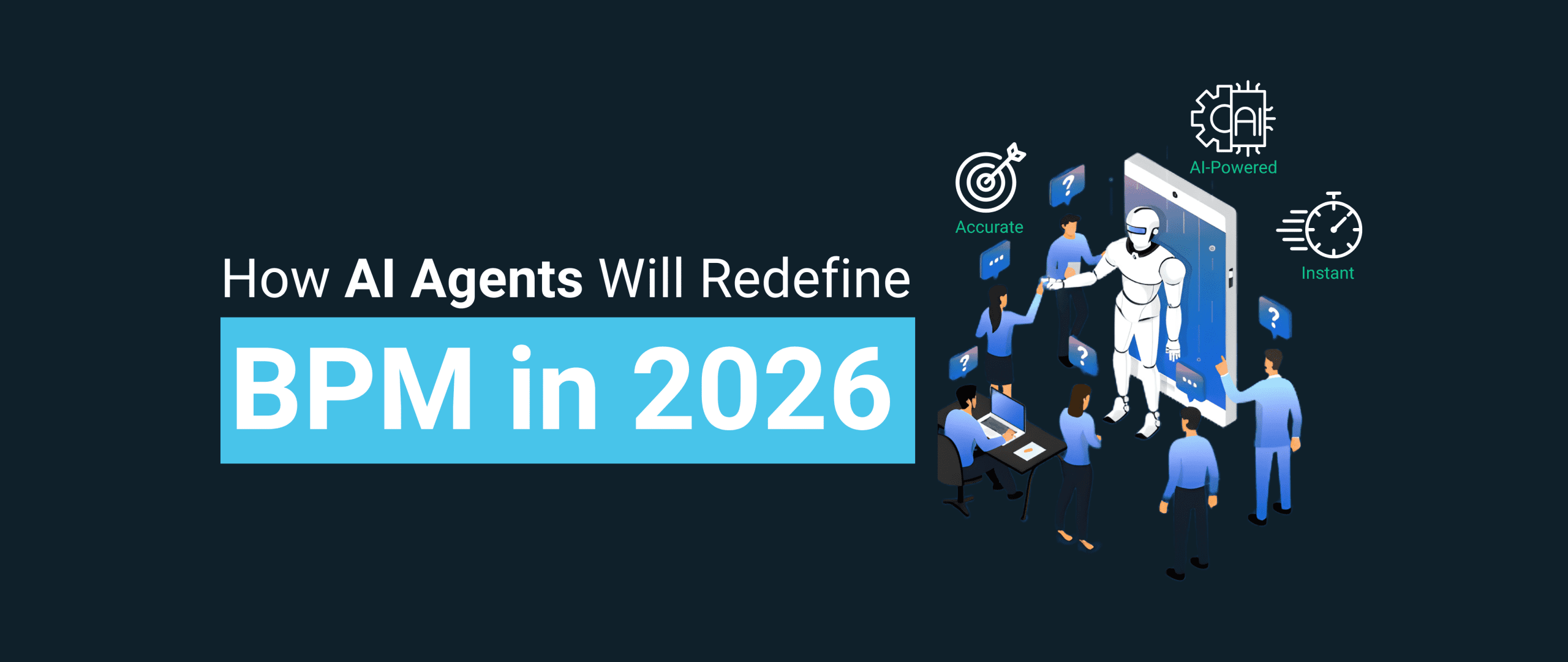
How AI Agents Will Redefine BPM in 2026
Artificial intelligence is moving faster than anyone expected, and it is quickly becoming a core part of how businesses operate. A recent survey revealed that around 78% of organizations are already using AI in at least one key business function, up from just 55% a short time ago.
That jump says a lot, AI isn’t a futuristic concept anymore; it’s becoming essential for staying competitive and making smarter decisions.
In an episode of BPM RealTalk, a BPM expert mentioned how AI is transforming decision-making by delivering real-time insights and recommendations that leaders can act on with confidence. Even that simple idea highlights how AI is reshaping what organizations can achieve when they have clarity at their fingertips.
And that’s exactly why BPM Trends 2026 is shaping up to be a major turning point. The old way of working, long process mapping exercises, slow analysis, scattered documentation, is giving way to AI-agents in BPM that bring speed, accuracy, and transparency into everyday operations. Instead of spending weeks digging for answers, businesses will have insights on demand.
The sections below take a closer look at what this shift means and how AI-agents are set to redefine BPM in the year ahead and beyond.
What AI-Agents in BPM Really Mean
AI-Agents in BPM go far beyond basic automation or simple workflow tools. Instead of just moving tasks from one step to another, they act as intelligent assistants that understand context, analyze data, and deliver instant insights. Their real strength lies in the speed they bring to process optimization.
With AI-Agents built into BPM platforms, the long cycles of mapping, analyzing and refining processes become dramatically faster. Work that once required weeks of manual effort can now be completed in seconds. This shift removes the heavy administrative burden that typically slows down improvement initiatives and gives teams more time to focus on strategic priorities and high-value decision-making.
In practical terms, AI-Agents help organizations move quickly, respond to change with confidence, and continuously improve without the bottlenecks of traditional BPM methods. They enable a more agile, forward-thinking way of working where people can concentrate on innovation, problem-solving, and growth — instead of paperwork and process maintenance.
How Will AI Agents Change BPM in 2026 and Beyond
Instead of incremental upgrades, the years ahead will reshape the fundamental ways organizations map, analyze, and govern processes. Four major shifts will define the new BPM era.
1. Process Mapping Will Become 90% Faster
One of the biggest frustrations with traditional BPM has always been the time and effort required to build process maps from the ground up. Workshops, interviews, and manual diagramming often consume weeks before any improvement work can even begin.
AI agents will eliminate that delay completely.
You no longer need to start from scratch. For instance, AI-powered process mapping tools by PRIME BPM can instantly convert existing flowcharts, whether in the form of images, PDFs, into editable, BPMN-compliant process maps.
What once took weeks now takes minutes, allowing teams to move quickly into the improvement and optimization phase instead of getting lost in documentation cycles.
This accelerates transformation efforts dramatically and makes continuous improvement achievable at scale.
2. Instant Answers Without Searching Through Process Maps
In most organizations, understanding process behaviour requires navigating complex maps and cross-referencing multiple systems.
With AI-agents, users can instantly ask and receive clear answers about what is happening, how tasks are being executed, and where inefficiencies exist.
No more digging through diagrams or chasing teams for information. Decision-makers gain real-time clarity at the moment they need it.
3. Turning Weeks of Analysis into Seconds
Traditional process analysis is often slow, requiring data collection, validation, interviews, and manual interpretation.
AI-powered process intelligence can analyze data instantly, identify bottlenecks, highlight improvement opportunities, and recommend changes in a short span of time.
This level of speed transforms operational decision-making from reactive to proactive, giving businesses the ability to act immediately and continuously optimize.
4. Audit-Ready and Compliance-Ready Documentation Automatically
Maintaining accurate and current documentation is a constant struggle, especially in regulated industries.
AI-agents are going to eliminate this burden by generating and updating documentation as processes evolve, producing standardized reports that are compliance-aligned and traceable at any time.
AI-based audit-ready documentation becomes effortless rather than panic-driven, and organizations reduce risk significantly
5. Process Insights Accessible to Everyone
Until now, deep BPM insight has often been limited to specialists.
AI-agents remove that barrier. Whether the user is a frontline manager, a compliance analyst, or an executive, they can interact with process information and get answers instantly.
This opens the door for broader participation, faster collaboration, and a culture where improvement is an everyday habit—not an annual initiative.
6. Simulate Outcomes Instantly, With Accuracy
One of the most groundbreaking capabilities AI-agents introduce is the ability to simulate process changes and predict outcomes before implementing them.
Instead of relying on assumptions or theoretical modelling, organizations can test different improvement ideas, compare scenarios, and understand the impact of changes without touching live operations.
AI-agents will make running simulations dramatically easier. You can simulate different improvement recommendations, “What if we remove this approval step?” or “What happens if we reduce handoffs between teams?”, and the AI will generate accurate responses based on your real process data. This means leaders no longer have to make decisions based on guesswork. They gain precise, evidence-backed insight to act with confidence.
AI simulation for business process improvement reduces the risk of disruption, improves decision certainty, and enables businesses to validate strategies before investing time, cost, or resources. Experimentation becomes safe, fast, and data-driven.
Why 2026 Will Be the Tipping Point
Several forces are converging to make 2026 a breakout year for AI-driven BPM:
- Rapid maturity of generative AI and machine learning models
- Increased adoption of unified process platforms over fragmented tool ecosystems
- Pressure for real-time visibility, agility, and resilience
- Rising regulatory demands require audit-proof documentation
- Enterprise-wide digital transformation and automation initiatives are accelerating globally
Organizations will not merely want AI agents. They will need them to remain competitive.
Looking Ahead
AI-agents represent a decisive shift in how organizations understand and improve their processes.
As 2026 approaches, organizations striving to stay ahead are turning to unified BPM platforms built for transparency, standardization, process intelligence, and measurable improvement.
PRIME BPM leads this evolution, combining two decades of BPM expertise with advanced AI to deliver speed, accuracy, and smarter decision-making. The AI-powered Process Mapping Bot allows you to build BPMN-compliant maps in seconds, while one-click analytics, simulations, and automated compliance ensure processes remain optimized and risk-proof.
Built for both business users and process experts, this BPM Software accelerates improvement, reduces costs, and strengthens governance, preparing organizations to compete confidently in an AI-driven era.
The future belongs to those who transform intelligently and continuously. PRIME BPM equips you to do exactly that.
See the future in action—Take a Quick Product Tour.