
Is AI in BPM Worth It? A Practical Cost vs Value Breakdown
Artificial Intelligence has become a big topic in almost every business and industry. According to the Stanford 2026 AI Index Report, generative AI reached over 50% global adoption in just three years, making it the fastest-adopted technology in history.
This shift makes one thing clear: AI is becoming a core part of how businesses operate.
When we look at the BPM space, this shift is already translating into real, measurable impact. AI is enabling faster implementation of process improvements, quicker and more informed decision-making, and the ability to drive operational excellence at scale.
Despite that, many organisations, especially SMEs, are still in a dilemma of whether it is worth investing in AI in BPM.
This blog will cut through the noise and evaluate AI in BPM cost vs value from a practical, operational lens.
What AI in BPM Actually Changes
Artificial Intelligence is bringing speed to business process management.
The traditional way of managing processes is heavy lifting, requiring lots of manual effort and time. BPM teams are being stretched thin to map, analyse, improve, and implement end-to-end processes within tight time constraints.
AI-powered business process management software is changing this complete scenario. With the use of BPM AI Agents, organisations can move faster from process mapping to analysis and improvement implementation with far better accuracy.
This is where the real benefits of AI in BPM start to become visible. Instead of spending time on repetitive tasks, teams can focus on solving problems and improving outcomes.
In simple terms, AI removes the friction around process management tasks, allowing teams to operate with more clarity, speed, and impact.
Understanding the Real Cost of AI in BPM
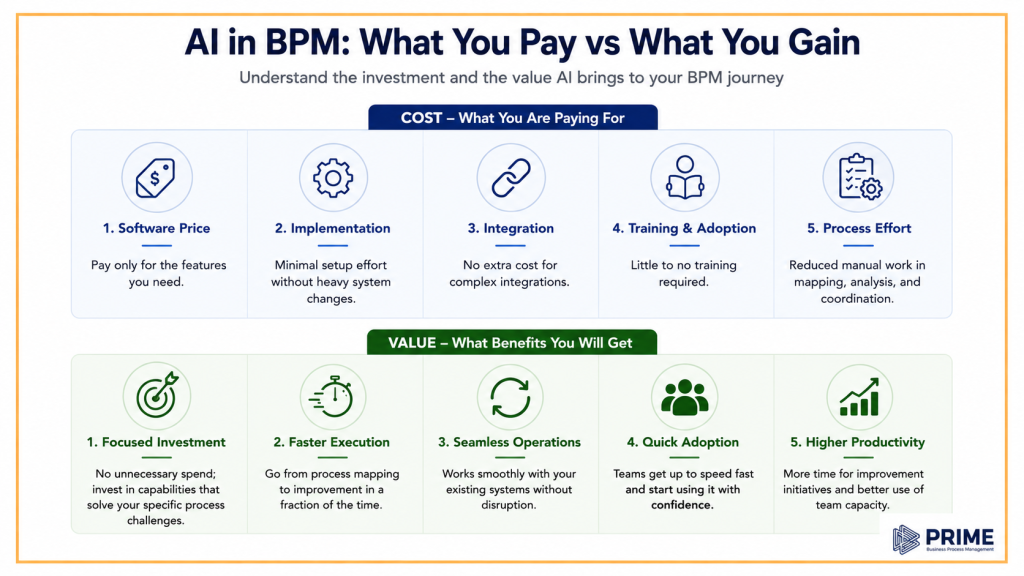
When people think about AI in BPM, the first assumption is usually high cost. But that’s not how modern BPM platforms are structured anymore.
The investment is far more practical and far more controlled. Instead of paying for everything up front, you’re essentially paying for what you need and when you need it.
Flexible Licensing Based on Usage
You don’t have to invest in a full suite of features from day one. Whether your priority is using AI agents for process mapping, analysis, documentation, or simply accessing process knowledge, alongside or independent of basic BPM capabilities, you can begin with what addresses your immediate needs.
As your requirements grow, you can expand gradually. This invests feel less like a large commitment and more like a step-by-step progression aligned with your goals.
Seamless Integration Without Heavy Disruption
Another concern is the cost associated with system integration, especially with existing systems.
BPM software with AI solutions today is built to work with existing systems. Rather than requiring a complete overhaul, they integrate into your current environment with minimal disruption.
This reduces both the complexity and effort typically associated with implementation, allowing teams to start seeing value faster.
Minimal Training, Faster Adoption
A tool is only useful if people actually use it. That’s why usability matters.
The purpose of building AI BPM solutions is to make it easy to use for business users, so they don’t need to rely on technical teams. The motive is to reduce the need for long BPM training courses or complex onboarding. Teams can start working with the system without feeling overwhelmed, which makes adoption much easier.
At the same time, platforms like PRIME BPM also offer strong customer support. So, if teams get stuck or need guidance at any stage, help is readily available. The customer support team always ensures that progress doesn’t slow down, and users stay confident while using the platform.
Investment That Connects to Outcomes
The biggest shift is in how the cost is tied to value.
You’re not investing in technology for the sake of it. You’re investing in capabilities that help you move faster, see clearer insights, and improve processes more effectively.
That’s what makes the cost feel justified, because it directly connects to what you’re trying to achieve.
Ultimately, the cost of AI in BPM is no longer about large upfront spending. It’s about making focused investments that grow with your needs and deliver value at each stage.
The Value Side: Where AI in BPM Delivers Real Returns
To evaluate the value side of artificial intelligence in business process management, let’s look at how quickly it turns efforts into outcomes.
Accelerated BPM Execution
AI significantly reduces the time it takes to move from process understanding to implementation.
For example, you can map your current process much faster by simply uploading existing information, whether it’s an Excel sheet, document, image, or even a recorded walkthrough. The AI process mapping agent converts it into a BPMN-compliant, ready-to-use process map within minutes. There’s no need to organise multiple workshops or spend hours manually building the process from scratch.
Once the process is mapped, integrated intelligent QA steps in to review it. It highlights missing steps, unclear roles, incomplete documentation, and logic gaps. Instead of manually checking everything, you get clear pointers on what needs to be fixed, making it easier to refine the process and move forward.
Additionally, AI-powered process analysis tools can quickly scan the entire process and provide insights into inefficiencies. It looks at flow, handoffs, approvals, exceptions, and overall structure, areas that usually take significant time to analyse manually. This removes a large part of the effort from BPM teams and analysts.
All of this helps teams spend less time on analysis and more time on implementation, so improvements happen faster and the execution gap that typically slows BPM initiatives starts to close.
Productivity Gains Without Hiring
AI BPM agents make a noticeable difference in how much work teams can actually get done, without needing to expand the team.
A lot of BPM effort today goes into tasks that are necessary but time-consuming, such as collecting inputs, documenting processes, reviewing details, and coordinating across teams. This is where AI in process management steps in. They take over a large part of this routine work, so teams are not constantly caught up in managing the process itself.
In many ways, it increases the team’s productivity. Rather than adding more people to keep up with demand, organisations can increase output by reducing the effort required per task.
Empowered Professionals
When routine work reduces, the role of BPM teams starts to change in a meaningful way.
Instead of focusing on non-value-adding tasks, teams can spend more time understanding problems, testing improvements, and driving real change.
The shift is similar to what we often see in improvement-led environments—people learn and grow by doing, not just by following instructions or attending training sessions.
It also builds confidence. When teams have access to clear insights and faster outputs, they are in a better position to make decisions and take ownership.
In simple terms, AI in workflow management empowers teams to contribute more to improvement initiatives.
Smarter, Data-Driven Decisions
AI agents continuously analyse process data and surface insights that are often missed in manual reviews. They highlight bottlenecks, inefficiencies, and patterns in real time, giving teams a clearer understanding of what’s actually happening across processes. This allows decisions to be based on evidence rather than assumptions, improving both speed and accuracy.
Accuracy and Consistency
Manual processes tend to vary depending on who is executing them, which can lead to inconsistencies and errors. Intelligent process management brings a level of standardisation by ensuring processes are documented, analysed, and followed in a structured way. This improves reliability and helps maintain consistency across teams and functions.
AI in BPM Cost vs Value: A Practical Reality Check
The Hidden Cost of AI in BPM That Can Impact Value
AI in BPM can deliver strong results, but only when it’s applied practically. There are a few things that don’t always get attention upfront, but they directly impact how much value you actually see.
Lack of Clear Ownership Slows Things Down
AI-powered BPM software can point out what needs to be improved, but someone still needs to take it forward. When it’s not clear who owns the next step, things tend to stall. Insights are there, but action is delayed. Having clear ownership makes a big difference in keeping improvements moving.
Low Adoption Limits the Impact
If teams are not using the platform regularly, the value stays limited. AI works best when it becomes part of everyday work—not something that’s used only occasionally. When it fits naturally into how teams operate, the impact is much more visible.
Trying to Do Everything at Once
It’s tempting to roll out AI across multiple processes at the same time, but that often creates more confusion than value. Starting small works better. Focus on a few key areas, see results, and then expand. It keeps things manageable and helps build confidence across the team.
So, Is AI in BPM Worth It?
At first glance, AI in BPM may seem like a significant investment. However, the value becomes clear in how dramatically it improves execution, accelerates process improvement, enhances team efficiency, and enables more consistent outcomes.
With AI, process improvements that once took weeks can now happen up to 90% faster. And when execution speeds up, the return follows.
So yes, AI in BPM is worth it. It helps organisations implement improvements faster, realize value sooner, and ultimately drive better business outcomes.
Want to learn more? Contact our BPM expert to get more clarification and get solutions as per your business needs.