
Moving from Central to Circular
Why isolated Centres of Excellence struggle to sustain operational excellence, and how a collaborative Circle of Excellence changes that.
Operational Excellence
Navigating Sustainability Challenges
Many organisations embark on the journey to operational excellence to achieve key business goals such as greater efficiency, productivity, and agility. A study indicates that over 40% of organisations are utilising operational excellence methodologies to achieve customer delight. However, while the number of organisations understanding the importance of operational excellence and initiating projects is significant, the number of organisations that are able to sustain these initiatives remains low.
This often occurs as organisations entrust operational excellence initiatives to a limited group of resources to drive. Despite these dedicated teams collecting the right process information and building detailed process maps, they often struggle to drive adoption, secure commitment from team members, and achieve desired outcomes.
The solution lies in moving operational excellence programs away from isolation and involving different layers of the organisation, including middle managers, team leaders, and executives, to commit to these programs. This is where the Circle of Excellence proves to be a game-changer.
What is a Circle of Excellence?
The Circle of Excellence revolutionises the approach to operational excellence by shifting from isolated efforts to collaborative engagement across the organisation. It fosters multi-layered involvement, ensuring that every role contributes effectively to drive engagement, adoption, and ultimately, success.

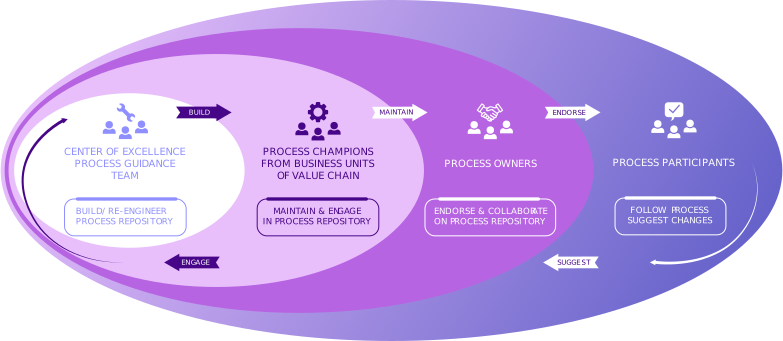
At its core, the Circle of Excellence merges the expertise of the Centre of Excellence with the active participation of other stakeholders in a unified journey towards operational excellence. It encompasses various roles, each with defined capacities to execute the cycle of building, maintaining, endorsing, suggesting, and engaging.
Circle of Excellence includes the following roles:
- Center of Excellence/Process Guidance team, which is responsible for building/re-engineering process repository.
- Process Champions from business units of value chain to engage in the creation and maintenance of process repository.
- Process Owners to endorse and collaborate on process repository.
- Process Participants to follow process and suggest changes.
Why
Circular Approach Vs Central Approach
Circle
of Excellence
Centre
of Excellence
How to Operationalise a Circle of Excellence
To establish a Circle of Excellence, three key elements must align:
Methodology, People, and Tool.

Methodology
A standard methodology focusing on driving Continuous Business Improvement is at the center of establishing a Circle of Excellence.
For a methodology to be systematic, structured, best practice and result oriented, it needs to have five phases:
Process Scoping
Process Review
Process Improvement
Process Implementation
Process Monitoring
People
This is the second pillar in establishing the Circle of Excellence. People with required skill set should be chosen and their responsibilities needs to be clearly defined. Below are the roles required to establish the Circle of Excellence and their individual responsibilities.
Process Guidance Team/ Process Analysts
- Facilitate Process Library Build Workshops
- Design and Maintain Process Library
- Mentor and Guide Process Champions
- Design, Analyse, Improve and Implement Processes
Process Champions/ Process Editors
- Design Business Unit Processes
- Maintain Process Maps and Related Documentation
- Implement Process Changes Based on Approved Change Requests
Process Owners
- Serve as the Gateway for Processes to End Users (Participants)
- Participate in Process Library Build Workshops
- Approve New Processes and Process Updates (Authorize Publishing)
- Reinforce and Support Process Management Within the Business Unit, Especially for Process Participants
Process Participants
- Participate in Process Interviews to Capture Current-State Process Information
- Participate in Process Confirmation Sessions Following Current-State Process Interviews
- Participate in Process Execution
- Provide Feedback on Processes and Improvement Ideas
- Participate in Process Improvement Projects
Tool
This is the third key element in establishing a Circle of Excellence. An end-to-end tool that takes the organisation through the phases of process mapping, analysis, redesign, implementation, change management, and collaboration and monitoring proves a game changer in the journey towards Continuous Improvement. A tool is a must-have as it drives the behaviour automatically. With thousands of processes in the business, an appropriate toolset is the only way to ensure business units are on the same page and mapping, analysing and improving consistently.
While there is no one-size-fits-all tool, organisations must assess their critical needs and evaluate tool requirements to make the right choice. However, certain features are considered must-haves in any tool.
Integrated Methodology
A toolset equipped with an integrated methodology offers users a comprehensive framework throughout the process enhancement journey, right from initial process design and analysis to iterative improvement and collaborative efforts. This ensures a seamless progression from one stage to the next, promoting a systematic and efficient approach to process optimisation. Opting for a BPM tool that embeds established best practices such as Six Sigma, Lean principles, and Value Stream Mapping can significantly enhance the output of process improvement endeavours.
In-built Analytics
Business Process Analysis is at the center of driving improvement initiatives. By delivering insights into potential areas for improvement, it helps organisations target their improvement initiatives. A tool that offers instant access to key metrics such as process time, value, cost, efficiency, and performance facilitates data-driven decision-making and fosters continuous improvement.
In-built BPMN
A tool embedded with a worldwide recognised language for modelling business processes, such as BPMN, ensures standardised documentation. This helps in creating accurate maps with the essential details.
Ready to Set Up Your Circle of Excellence?
When setting up a Circle of Excellence, it's crucial to identify the right governance model for your process mapping team. Based on your current business process maturity, you need to evaluate centralised or decentralised which governance model works for your process mapping team.
Watch this 30-min On-Demand Process Governance Crash Course to Assess your Organisation's Process Maturity and choose the best-fit Governance Model.
