
Current-State Process Mapping: Why It Matters for Business Process Improvement
- What Is Current-State Process Mapping?
- The Hidden Cost of Working Without Current Process Visibility
- How Current State Process Mapping Supports Business Process Improvement
- Key Benefits: The Business Impact of Current-State Mapping
- How AI Is Changing the Way Businesses Map Current Processes
- Current State Process Mapping Vs Future State Process Mapping : Why Both Matter
- Process Mapping Mistakes That Might Slow Improvement Efforts
- Current State Process Maps are the Starting Point of Process Excellence
Summary
Many business leaders have experienced this firsthand : despite putting time, effort, and budget into process improvement, the same operational issues keep showing up again and again. In most cases, the problem is that the existing workflows were never fully understood in the first place. Current-state process mapping helps businesses clearly see how work actually moves across teams, systems, and approvals, making it easier to spot bottlenecks, inefficiencies, and gaps before making changes. With smarter and faster mapping approaches now available, organisations can spend less time figuring out where the problem is and more time improving operations that truly need attention.
Process mapping is often the foundational step behind successful business process improvement initiatives. Before organisations can optimise workflows, they first need a clear understanding of how their current processes actually operate. Current-state process mapping provides that visibility of the inefficient tasks that may otherwise go unnoticed. More importantly, it creates a clear path for where improvements should happen and where operational changes will have the greatest impact.
The growing importance of process mapping is also reflected in industry research. According to the Global BPM Trends survey, over 63% of BPM professionals use process mapping to support continuous improvement initiatives. The findings clearly show that organisations continue to view process visibility as a critical driver for operational excellence and long-term business success.
At the same time, technologies like AI are beginning to reshape how organisations approach process mapping, making it easier to capture what’s happening and gain deeper operational insights.
This guide explores why current-state process mapping matters, the business value it delivers, how AI is influencing modern process mapping, and why understanding the current state remains essential for successful business process improvement.
What Is Current-State Process Mapping?
Current-state process mapping is a form of business process mapping that helps organisations document and visualise how work flows currently. It captures what’s currently happening across teams, systems, approvals, and activities from start to finish.
They help businesses understand root cause of inefficiencies, including delays, handoffs, bottlenecks, and manual interventions that may otherwise go unnoticed.
By creating a clear view of existing workflows, you can identify where improvements are needed before redesigning or automating processes.
The Hidden Cost of Working Without Current Process Visibility
Many operational challenges businesses face today are directly connected to poor process visibility. When organisations lack a clear understanding of how work moves across departments, inefficiencies become difficult to identify and even harder to fix.
Without current process visibility, businesses often end up improving workflows that are already inefficient or poorly structured. This can create false outcomes where the process may appear improved on the surface but still continues to cause delays, errors, and operational gaps behind the scenes.
Over time, this leads to frustration across teams, increased costs, wasted time, inefficient use of resources, and improvement initiatives that fail to achieve the desired business goals.
For example, a customer request may move through several departments using different systems and communication methods. If one step is delayed or information is missed, the entire workflow slows down. Without proper process visibility, businesses often address only the visible issue instead of identifying the root cause affecting the entire process.
This is why reducing inefficiencies through process mapping has become increasingly important for businesses aiming to improve operational visibility and performance.
How Current State Process Mapping Supports Business Process Improvement
Business process improvement starts with understanding how processes currently function.
Current-state process mapping provides the clarity businesses need to identify what is working, what is slowing operations down, and where improvement opportunities exist. It creates a baseline that helps organisations measure performance and prioritise process optimisation efforts more effectively.
It helps organisations:
Exposes the “Invisible Work” Slowing Operations Down
Many operational inefficiencies are not immediately visible. Employees often create manual workarounds, follow unofficial steps, or rely on emails and spreadsheets to keep processes moving. Over time, these hidden activities become normalised within the organisation.
Current-state mapping brings these invisible inefficiencies to the surface, helping businesses understand where unnecessary complexity exists and why certain workflows consistently underperform.
Helps Identify Root Causes Instead of Surface-Level Problems
Rather than only addressing visible delays or errors, current process maps helps businesses trace where inefficiencies actually begin, making it easier to solve operational issues at their source.
Creates Alignment Between Leadership and Operational Teams
One of the biggest challenges in process improvement is that leadership teams and operational staff often have different views of how processes actually work. Current-state process maps helps teams understand how their activities connect with other departments, improving coordination and reducing communication gaps.
Helps Prioritise High-Impact Improvements
Not every inefficiency affects the business equally. Current-state process maps also support better process improvement strategies by helping organisations prioritise changes based on operational impact.
Reduces the Risk of Failed Improvement Initiatives
Improving an unclear or inefficient process often leads to higher costs, employee frustration, and disappointing results.
Current-state mapping reduces this risk by creating a reliable foundation for process redesign, automation, and digital transformation initiatives.
Whether a business plans to improve customer service, increase operational efficiency, or prepare for digital transformation, current-state process mapping provides the visibility needed to make meaningful changes with confidence.
Key Benefits: The Business Impact of Current-State Mapping
Current-state process mapping delivers value far beyond documentation. It supports operational performance improvement by helping businesses focus on improving workflows and operations with greater clarity and consistency.
Improved Operational Efficiency
When businesses clearly understand how work flows, they can identify unnecessary steps, eliminate delays, and reduce wasted effort. This leads to faster processes and improved productivity.
Better Cross-Functional Collaboration
Process mapping creates a shared understanding across departments. Teams gain visibility into their responsibilities, dependencies, and how their work impacts other areas of the organisation.
Faster Identification of Process Gaps
Current-state maps help businesses quickly identify bottlenecks, communication breakdowns, and workflow inconsistencies that may be affecting performance.
Smarter Decision-Making
Instead of relying on assumptions or fragmented feedback, organisations can use process insights to make informed operational decisions backed by real workflow visibility.
Stronger Compliance and Governance
Standardized workflows reduce process variation and improve accountability. This helps businesses maintain better compliance and reduce operational risks.
Improved Customer Experience
Internal inefficiencies often impact customers directly. Smoother workflows, faster approvals, and reduced delays help businesses deliver more consistent and responsive customer experiences.
Organisations that invest in business process management software to gain process visibility are often better positioned to improve agility, scalability, and long-term operational performance.
How AI Is Changing the Way Businesses Map Current Processes
Traditional process mapping has often been a time-consuming exercise involving workshops, interviews, manual documentation, and repeated reviews. While these methods help businesses understand workflows, they also require significant effort from BPM teams, operational staff, and process owners.
AI is now transforming this approach by making process mapping faster, smarter, and far more data-driven. Instead of spending weeks manually documenting workflows, businesses can use AI-powered capabilities of best BPM solutions like PRIME BPM to instantly capture, analyse, and structure processes with greater speed and accuracy.
Here’s how AI is changing the way organisations map current processes:
Converts Multiple Form of Inputs into Process Maps in Minutes
AI-powered best business process mapping tools can transform process information present in any form of input such as an image, a video, a spreadsheet or even a recording of conversations, into structured BPMN-compliant process maps in minutes. What takes weeks of efforts to collect and validate data can be done in minutes.
Reduces Manual Process Mapping Effort
Instead of relying heavily on workshops, interviews, and manual diagramming, AI saves efforts required to do documentation work, allowing BPM teams to focus more on improvement initiatives.
Detects Gaps, Errors, and Missing Steps Faster
AI can automatically identify logic gaps, inconsistent naming conventions, redundant activities, missing approvals, and workflow errors that are often missed during manual reviews.
Provides Faster Visibility Into Bottlenecks and Inefficiencies
AI-driven process analysis helps organisations quickly detect delays, excessive approvals, rework loops, waiting times, and non-value-adding activities across workflows. Teams can quickly mover forward from process mapping to implement process improvement with the quick insights.
Improves Process Standardisation Across the Organisation
AI helps businesses create more consistent and standardised process maps, reducing variations between teams and improving operational alignment.
Supports Better Process Improvement Decisions
By analysing workflows against operational guardrails and best practices, AI helps organisations prioritise high-impact improvement opportunities with greater confidence.
Supports Better Process Improvement Decision
By analysing workflows against operational guardrails and best practices, AI helps organisations prioritise high-impact improvement opportunities with greater confidence.
Solutions like PRIME BPM AI Agents are helping organisations reduce manual effort, improve process accuracy, and accelerate process improvement initiatives by up to 90%.
Current State Process Mapping Vs Future State Process Mapping : Why Both Matter
Current-state and future-state process mapping work together to support successful business improvement initiatives. While both serve different purposes, organisations need both perspectives to drive effective transformation.
Here’s the clear current state vs future state mapping comparison to understand better:
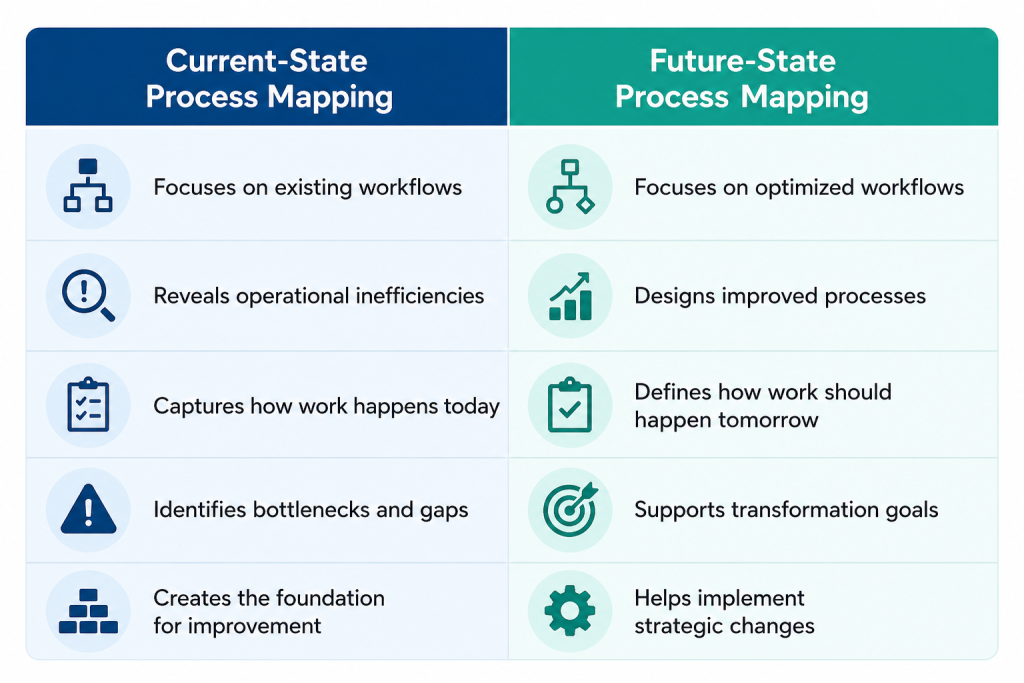
Current-state mapping helps businesses understand where problems exist, while future-state mapping focuses on designing more efficient workflows and operational models.
Without understanding the current state, businesses may design future processes that fail to address the actual operational challenges affecting performance today. This is why successful process improvement initiatives always begin with current-state visibility before moving toward future-state transformation.
Process Mapping Mistakes That Might Slow Improvement Efforts
Process mapping can deliver significant business value, but only when done correctly. Many organisations unintentionally reduce the effectiveness of their improvement efforts by making common mapping mistakes.
Mapping Assumptions Instead of Reality
One of the biggest mistakes businesses make is documenting how processes are supposed to work instead of how they actually operate. This creates inaccurate process visibility and hides operational inefficiencies.
Ignoring Employee Input
Frontline employees often understand workflow challenges better than anyone else. Excluding them from the mapping process can lead to incomplete or unrealistic process documentation.
Overcomplicating Process Maps
Highly detailed or overly technical process maps can become difficult to understand and maintain. Effective process mapping should prioritize clarity and usability.
Treating Process Mapping as a One-Time Activity
Business operations continuously evolve. Organisations that fail to review and update process maps regularly may lose visibility into changing workflows and emerging inefficiencies.
Focusing Only on Individual Departments
Processes rarely operate within a single team. Mapping only departmental activities can overlook critical dependencies, communication gaps, and workflow delays across the organisation.
Avoiding these mistakes helps businesses create process maps that deliver long-term operational value and support continuous improvement initiatives more effectively.
Current State Process Maps are the Starting Point of Process Excellence
Process excellence begins with visibility. Businesses must first understand how their operations currently function before they can improve efficiency, reduce complexity, or scale effectively.
Current-state process mapping provides that foundation. It helps organisations uncover inefficiencies, align teams, improve accountability, and make informed decisions based on real operational insights rather than assumptions.
As businesses continue navigating changing customer expectations, digital transformation, and operational pressures, process visibility has become more important than ever. Organisations that clearly understand their current workflows using business process software are better positioned to improve agility, and strengthen customer experiences. They can grow with exception ratio in the competitive business environment.
Book a 5-min product tour of PRIME BPM to explore how you can streamline process mapping and improve operational visibility across the organisation.