

Table of Contents
Summary
Investing in BPM Software helps organizations achieve more with less by reducing costs, saving time, and improving productivity. With AI, organizations can now complete the BPM cycle—from mapping and analysis to improvement and measurement—up to 90% faster, making continuous improvement and operational excellence more achievable.
Your organisation already runs on processes. Employees understand what they need to do. The most important processes are already documented on paper, in Excel sheets, in Word documents, or as process maps and SOPs sitting in a shared folder. So why should you invest in Business Process Management (BPM) software?
It is a fair thing to ask about before investing in business process management software.
The key thing to understand is that BPM software is not only for documenting processes. Its real value is how it makes it easier to understand your processes, analyse them to improve and maintain them, and measure the best outcomes.
The question is whether your current approach to managing processes is helping your organisation improve or simply helping it keep things running.
Once you look at the time, effort, and opportunities involved, you can start to determine whether BPM software can deliver enough measurable value to justify the investment.
What Is the Cost of Managing Processes Without BPM Software?
Consider the traditional way of managing processes. What happens when someone needs to understand an existing process to improve it?
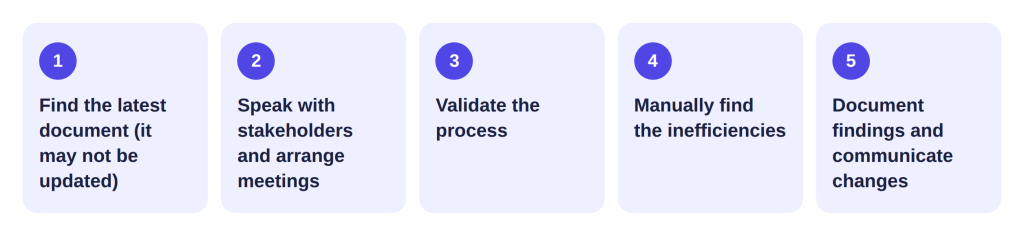
Now multiply this by 1000s of processes that are running in a company. You can imagine the amount of effort it takes.
So, the major cost of managing processes without BPM software is time, effort, and resources. After putting in all these efforts, you cannot say that the process is accurate and reflects how the work is actually performed.
What Does BPM Software Actually Change?
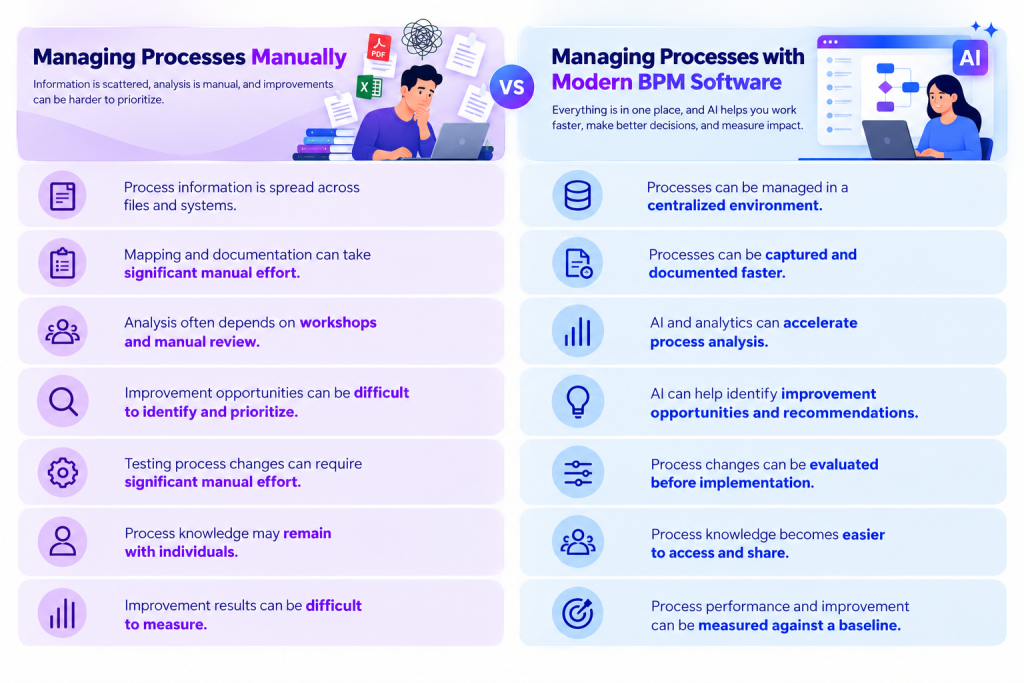
With the above comparison, the value of BPM software becomes clearer.
BPM software makes it easy to map, analyse, improve, and monitor processes, so that your business operations run in an efficient way and help you get better outcomes.
More importantly, AI is changing how quickly this work can be done. Modern AI-powered BPM software can help teams map, analyse, and improve processes up to 90% faster. It reduces the manual effort involved in process management and helps teams move from process discovery to improvement in days.
Where Can BPM Software Create Real Business Value?
When you are able to better manage your processes, you will get measurable improvements in the business. Here are some real business values you will get after investing in the best business process management software.
Reduce Operating Costs
A process may look efficient on paper, but the reality of execution can tell a different story. Delays, unnecessary handoffs, duplicate work, and manual activities can quietly increase the cost of getting work done.
When you manage processes using BPM software, you can easily identify where processes consume unnecessary time and resources. It will show you delays, redundant tasks, non-value-adding activities, or other inefficiencies.
You can then target these opportunities to reduce the cost of process execution and eliminate operational costs that you can avoid.
Increase Productivity and Capacity
If you have inefficient processes, you might be wasting employee time that could be utilised in higher-value work.
Improving process efficiency can reduce repetitive effort and delays, allowing teams to handle more work with the same resources. This can increase capacity without requiring a proportional increase in headcount.
Turn Process Knowledge Into an Organisational Asset
Process knowledge should not be dependent solely on people who perform a process.
You must have experienced employees in your organisation who know how work is done. But when they leave the company, it becomes difficult to get that knowledge.
Process knowledge should not be only in human heads. If process information is scattered and undocumented, teams end up wasting time searching for information. Even transferring knowledge to new employees becomes harder. The processes will be challenging to communicate.
With BPM software, you will get a centralised process environment that can serve as a reliable knowledge repository.
Maintaining this repository becomes more important at the time of implementing a new system, staff transition, and initiating transformation.
Improve Customer Service
A well-organised process system directly benefits your customers. When processes are well designed and consistently managed, operations run more smoothly, enabling you to deliver products and services faster and more reliably. This creates a more consistent customer experience and helps build customer satisfaction and trust.
Improve Operational Consistency
When similar processes are performed differently across teams, departments, or locations, organisations can experience inconsistent outcomes, duplicated effort, and difficulty maintaining standards.
Process standardisation can reduce this variability, improve consistency, and create a more predictable way of working across the organisation.
Reduce the Risk and Cost of Change
Process improvement can create new costs when changes are implemented without understanding their wider impact. Assessing the potential effect of a change before implementation can help organisations avoid costly mistakes and select improvement scenarios that deliver better outcomes for cost, efficiency, and customer service.
Measure the Return From Process Improvement
The real value of BPM software is not simply that processes become easier to manage. It is that organisations can connect process improvements to measurable business outcomes.
Ultimately, BPM software can create value in two connected ways: by reducing the cost and effort of running inefficient processes, and by helping organisations make better decisions about where and how to improve them.
How Do You Measure the Business Value of BPM Software?
Even though you have decided to invest in BPM software, measuring the real value is still a task. Some organisations measure its value by the number of process maps created, or the number of users added. However, it is important to understand that you need to look at what business benefits you will get.
So the right way of measuring the value is:
Establish Your Baseline
Understand what the current process management approach is costing.
For example, track:
- Hours required to map a process
- Hours required to analyse a process
- Time spent maintaining process documentation
- Time spent locating process information
- Process cycle time
- Manual effort
- Rework
- Errors
- Delays
- Cost per transaction
- Resources involved in the process
You do not need to measure everything.
Start with the high-frequency, high-impact, customer-related processes where the impact is high enough to make meaningful improvements.
Measure What Changes With BPM Software
Once the BPM platform is in use, measure the same activities again.
Multiply the 30-hour saving across the number of processes your organisation manages, and connect each change to something the business understands.
Note: To evaluate this, you do not need to buy a licence. You can choose software like PRIME BPM, which offers a 15-day free trial.
What Does BPM ROI Look Like in the Real World?
Here are some real-world success stories to show you the BPM ROI:
These examples highlight an important lesson:
You do not need to measure the value of BPM across the entire organisation on day one.
You can start with one process where the potential impact is clear, measure the current state, improve it, and use the results to understand what broader BPM investment could deliver.
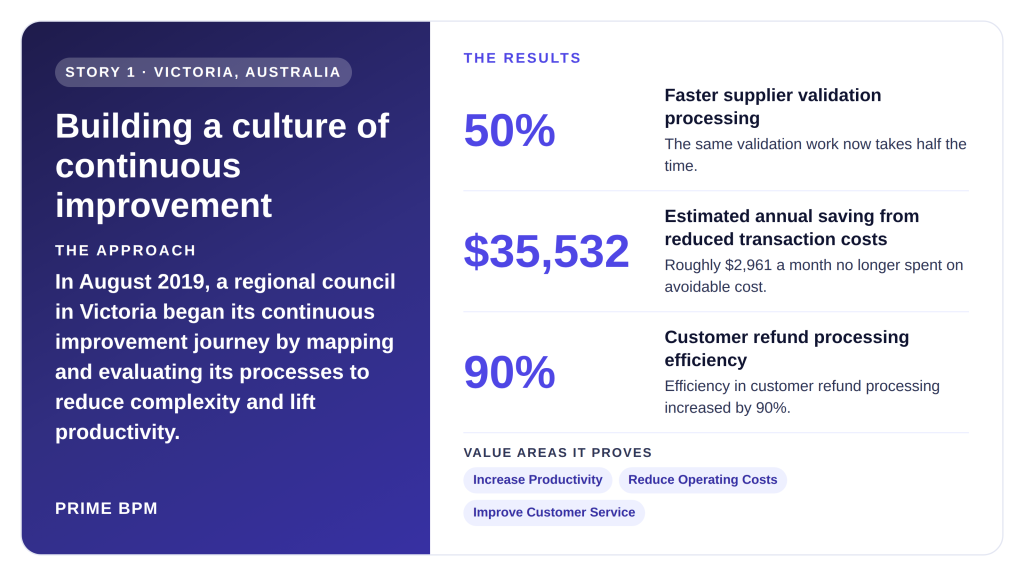
Read the full success story: Victorian Council Creates a Culture of Continuous Improvement with PRIME BPM
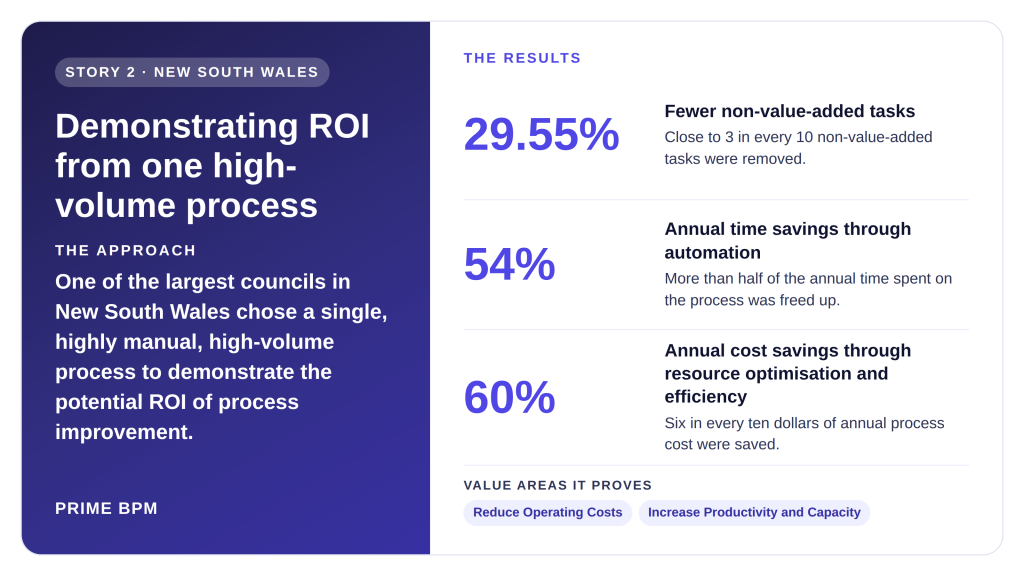
Read the full success story – Australian Council’s Journey to Time and Cost ROI Through BPM
So, Is BPM Software Worth the Investment?
The answer depends on how much effort your team is putting into managing processes without BPM software and what value they are achieving.
If your teams spend significant time documenting, analysing, maintaining, and improving processes, that effort already represents an operational cost.
If inefficient processes create delays, rework, unnecessary manual work, inconsistent execution, or missed automation opportunities, those costs also exist whether you measure them or not.
Process management software like PRIME BPM brings those costs into view. Your teams can map, analyse, improve, and monitor processes in one place, and its AI capabilities help them go from process discovery to improvement in days.
The business case becomes even stronger when you can demonstrate measurable.
That approach changes the conversation from:
“Why should we spend money on BPM software?”
to:
“What is it costing us to manage this process the way we do today, and how much value could we create by managing it better?”
PRIME BPM gives you the tools to answer that question with your own numbers, and that is what makes the investment worth evaluating.